
⚡ The Bottom Line
The best email marketing software for ecommerce combines native store integrations, automated cart recovery, and behavioral segmentation.
Top platforms include Adflipr, Klaviyo, Omnisend, and Mailchimp — each suited to different store sizes and budgets. For most growing Shopify or WooCommerce stores, a dedicated ecommerce email tool will outperform a generic newsletter platform in revenue generated per subscriber.
Key stats: According to the Baymard Institute, the average cart abandonment rate is 69.99%. A well-configured email recovery sequence alone can recapture 5–15% of that lost revenue.
Running an ecommerce business is not as simple as launching a store and driving traffic. Customer acquisition costs are climbing the average cost to acquire an ecommerce customer through paid ads rose by 222% over the past eight years, according to SimplicityDX. Competition is growing across every niche, and shoppers have more choices than ever before.
Many store owners focus heavily on getting new visitors through Facebook Ads, Google Ads, and social media. But the real challenge begins after a visitor leaves your website without buying. This is where the right ecommerce email marketing software can transform your business economics.
Email gives you a direct, owned communication channel one that does not depend on ad budgets, algorithm changes, or platform fees. The DMA reports that email delivers an average ROI of $42 for every $1 spent, making it the highest-returning digital marketing channel available to online retailers.
Whether you run a Shopify store, a WooCommerce store, or a custom ecommerce website, this guide breaks down what to look for, how the top platforms compare, and how to set up the automations that generate revenue while you sleep. The best email campaign software for online stores should make it simple to automate, personalise, and measure every message you send to your customers.
Why Email Marketing Is the Highest-ROI Channel for Ecommerce
Most ecommerce brands spend thousands of dollars every month acquiring new customers. While acquisition matters, long-term profitability almost always hinges on how well you retain and monetise existing customers. Consider these benchmarks:
📈 Industry Benchmarks
Cart abandonment rate: 69.99% average across industries (Baymard Institute, 2024) Email marketing ROI: $42 per $1 spent — highest of any channel (DMA, 2023) Repeat customers spend 67% more than new customers (BIA/Kelsey) Acquiring a new customer costs 5-7x more than retaining an existing one (Invesp) Welcome email open rates average 50–60% 3x higher than standard campaigns (Omnisend, 2024)
Think about a typical shopping journey. A visitor browses your store, adds an item to their cart, then leaves without buying. Without a structured follow-up strategy, that potential sale is gone forever. With email automation, you can:
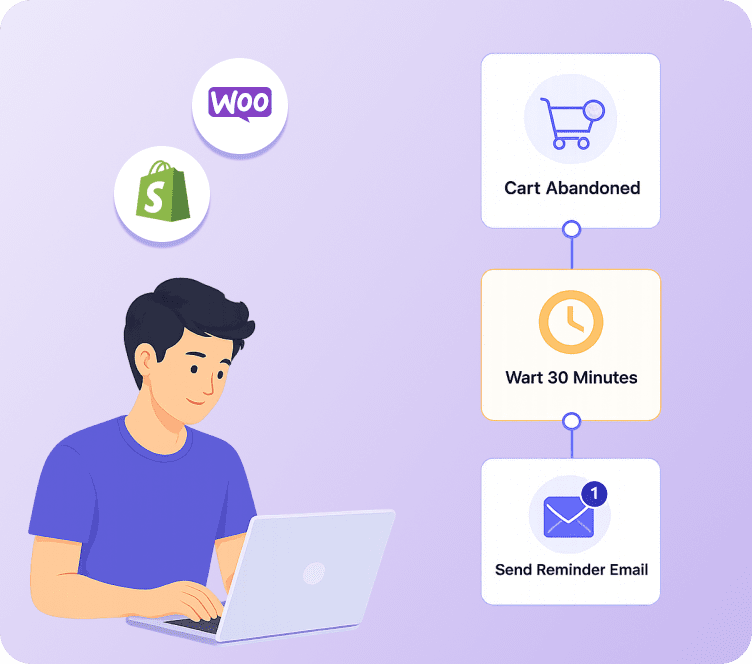
- Send a cart recovery email within 1 hour of abandonment
- Follow up with a second email 24 hours later with social proof
- Offer a time-limited discount on day three if they still have not purchased
That three-email sequence, sent automatically, consistently recovers 5–15% of abandoned carts for most ecommerce stores.
What Makes the Best Email Marketing Software for Ecommerce?
Not all email platforms are built for online stores. General-purpose tools may handle newsletters well but lack the ecommerce-specific automation and integrations that drive meaningful revenue. Here is what to prioritise:
1. Native Ecommerce Integrations
Your email platform must connect directly to your store without complex workarounds. Look for native, bi-directional integrations with:
- Shopify (including Shopify Plus)
- WooCommerce
- Magento / Adobe Commerce
- BigCommerce
- Custom storefronts via API
A native integration means customer data, purchase history, product catalogue, and real-time order events sync automatically — so your emails always reflect accurate, up-to-date information.
2. Behavioural Segmentation
Every customer behaves differently. A first-time visitor should not receive the same email as a VIP customer who has placed 12 orders. Advanced segmentation lets you target subscribers based on:
- Purchase history and frequency
- Average order value
- Products viewed or wishlisted
- Geographic location
- Email engagement level (opens, clicks)
- Days since last purchase
Segmented campaigns consistently generate 14–760% higher revenue per recipient compared to non-segmented blasts (Mailchimp internal data, 2023).
3. Ecommerce Marketing Automation
Automation is where email marketing software for ecommerce stores earns its keep. The best platforms let you build workflows that trigger automatically based on customer actions — no manual sending required. Essential automations include:
- Welcome series for new subscribers
- Abandoned cart recovery (1hr, 24hr, 72hr sequence)
- Browse abandonment emails
- Post-purchase follow-ups and cross-sells
- Product replenishment reminders
- Customer win-back campaigns
Choosing the right ecommerce marketing automation software means looking beyond simple drip campaigns you need fully triggered, store-integrated workflows that fire automatically based on real customer behaviour in your store.
4. Revenue Attribution & Analytics
You need to know which emails are actually making money, not just which ones get opened. Prioritise platforms that show:
- Revenue generated per campaign
- Revenue per subscriber over time
- Conversion rate by automation workflow
- Attributed revenue from cart recovery sequences
- Subscriber lifetime value tracking
5. Easy-to-Use Email Builder
Store owners should be able to launch campaigns without a developer. Look for a drag-and-drop builder with ecommerce-specific blocks including live product feeds, price pulls, and review embeds — all responsive on mobile out of the box.
Best Email Marketing Platforms for Ecommerce: Side-by-Side Comparison
Here is how the leading platforms compare on the features that matter most for ecommerce stores. When evaluating email campaign software for online stores, these are the dimensions that separate purpose-built ecommerce tools from generic newsletter platforms:
| Feature | Adflipr | Klaviyo | Mailchimp | Omnisend | ConvertKit |
| Starting Price | Free plan $8/mo | $25/mo | $16/mo | $16/mo | $13/mo |
| Ecommerce Focus | ✅ High | ✅ Very High | ⚠️ Medium | ✅ High | ⚠️ Medium |
| Shopify Integration | ✅ Native | ✅ Native | ✅ Native | ✅ Native | ✅ Native |
| WooCommerce Integ. | ✅ Native | ✅ Native | ⚠️ Limited | ✅ Native | ✅ Native |
| Cart Recovery Email | ✅ Yes | ✅ Yes | ✅ Yes | ✅ Yes | ⚠️ Basic |
| Browse Abandonment | ✅ Yes | ✅ Yes | ❌ No | ✅ Yes | ❌ No |
| SMS Marketing | ❌ No | ✅ Yes | ✅ Yes | ✅ Yes | ❌ No |
| Predictive Analytics | ⚠️ Basic | ✅ Advanced | ⚠️ Basic | ⚠️ Basic | ❌ No |
| Free Trial | ✅ Yes | ✅ Yes | ✅ Yes | ✅ Yes | ✅ Yes |
| Best For | Growing DTC brands | Revenue-first | Beginners | Omnichannel | Bloggers |
* Pricing based on up to 500 contacts. All platforms offer free trials. Verify current pricing on each provider’s website as rates may change.
Each platform suits a different type of store:
- Adflipr — Best for growing direct-to-consumer brands that want powerful automation without Klaviyo’s price tag
- Klaviyo — Best for high-revenue Shopify stores that need advanced predictive analytics and are willing to pay for it
- Mailchimp — Best for absolute beginners starting their first email list
- Omnisend — Best for stores that want email and SMS managed in one platform
- ConvertKit — Best for creator-led stores (courses, memberships, digital products)
Email Marketing for Shopify Stores: What You Need to Know
Shopify powers over 4.6 million online stores worldwide. If you are on Shopify, your email marketing platform needs to go beyond what Shopify Email (the built-in tool) offers.
| Feature | Shopify Email | Dedicated Ecommerce Email Tools |
| Browse abandonment | ❌ No | ✅ Yes |
| Advanced segmentation | ⚠️ Basic | ✅ Full behavioural |
| Multi-step automation | ⚠️ Basic | ✅ Unlimited steps |
| Revenue attribution | ⚠️ Basic | ✅ Detailed reports |
| A/B testing | ⚠️ Limited | ✅ Advanced |
| SMS + Email combined | ❌ No | ✅ Yes |
For Shopify stores doing less than $1,000/month in revenue, Shopify Email covers the basics for free. Once you cross that threshold, a dedicated platform’s advanced automation and segmentation will generate significantly more revenue than the tool costs each month. Dedicated email marketing software for ecommerce stores gives you the store-native triggers, segmentation depth, and revenue attribution that Shopify Email simply cannot match.
When connecting Adflipr (or any dedicated tool) to Shopify, you gain:
- Real-time sync of product catalogue and inventory
- Automatic customer tagging based on purchase behaviour
- One-click browse and cart abandonment workflows
- Dynamic product recommendations pulled directly from your store
- Revenue tracking tied to individual email clicks
Email Marketing for WooCommerce: Choosing the Right Integration
WooCommerce is the most widely used ecommerce plugin globally, powering over 6.6 million websites. Unlike Shopify (a hosted SaaS platform), WooCommerce runs on WordPress — which means your email marketing setup requires a plugin-based or API integration.
What to Look for in a WooCommerce Email Integration
- A dedicated WooCommerce plugin (not just a Zapier workaround)
- Real-time order and customer data syncing into the email platform
- WooCommerce-specific triggers: order placed, order completed, product reviewed, refund issued
- Support for WooCommerce Subscriptions and memberships
- Custom field syncing for WooCommerce product attributes
WooCommerce + Adflipr Setup
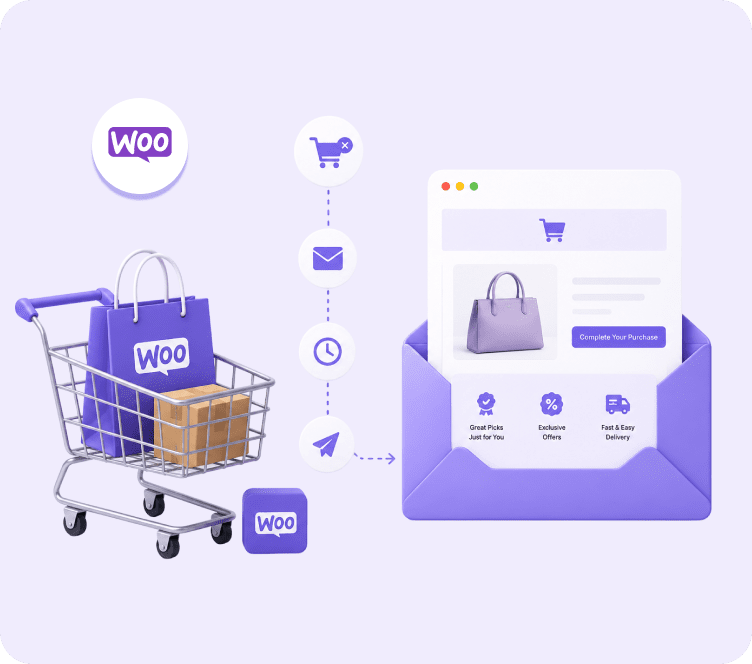
Adflipr connects to WooCommerce via a native plugin available from the WordPress plugin directory. Once installed, it automatically imports your existing customers, order history, and product catalogue. New orders, abandoned carts, and customer actions sync in real time.
The connection enables the same powerful automation available to Shopify users: cart recovery sequences, browse abandonment emails, post-purchase flows, and product replenishment campaigns — all triggered automatically from WooCommerce events.
Essential Email Automation Workflows Every Ecommerce Store Should Run
These seven automations form the foundation of a revenue-generating ecommerce email programme — and represent the core workflows that every serious ecommerce marketing automation software should support out of the box. Set them up once and they work continuously in the background.
1. Abandoned Cart Recovery Series
Trigger: Trigger: Customer adds to cart but doesn’t complete checkout within 60 minutes.
Email 1 (1 hour after): Friendly reminder with product image and direct link back to cart Email 2 (24 hours): Social proof — reviews of the product they left behind Email 3 (72 hours): Time-limited incentive (5–10% off, or free shipping)
💡 Why it works: Average recovery rate: 5–15% of abandoned carts. For a store with 1,000 monthly abandoners at a $50 AOV, that is $2,500–$7,500 in recovered revenue monthly.
2. Welcome Email Series
Trigger: Trigger: New subscriber joins your email list.
Email 1 (immediate): Brand welcome, your story, best-selling collections Email 2 (day 2): Social proof — reviews, press mentions, customer photos Email 3 (day 5): Incentive to make first purchase (discount or free shipping)
💡 Why it works: Welcome emails generate 320% more revenue per email than standard promotional messages (Experian, 2022).
3. Browse Abandonment Emails
Trigger: Trigger: Subscriber views a product page but doesn’t add to cart.
Email 1 (4 hours after): Show the exact product they viewed with relevant reviews Email 2 (48 hours): Show related or complementary products
💡 Why it works: Browse abandonment emails have lower volume than cart recovery but significantly higher open rates — often 40–50% — because the products are highly relevant to that specific subscriber.
4. Post-Purchase Flow
Trigger: Trigger: Order confirmed.
Email 1 (immediate): Order confirmation with estimated delivery Email 2 (day 3): Product usage tips or getting started guide Email 3 (day 7): Request for a review (time this to after likely delivery) Email 4 (day 21): Cross-sell related products based on what they bought
💡 Why it works: Post-purchase emails build loyalty and significantly increase the probability of a second purchase — the hardest conversion to achieve in ecommerce.
5. Product Replenishment Reminders
Trigger: Trigger: X days after purchase of a consumable product.
Works for: supplements, skincare, pet food, coffee, candles, cleaning products Email sent 80–90% of the product’s expected lifespan before the customer runs out Include a one-click reorder button for maximum conversion
💡 Why it works: Replenishment emails have some of the highest conversion rates of any automated campaign — often 10–20% — because they target customers at the exact moment they need to repurchase.
6. Win-Back Campaign
Trigger: Trigger: Customer has not purchased in 90, 120, or 180 days (set based on your average purchase frequency).
Email 1: ‘We miss you’ message with personalised product recommendations Email 2 (7 days later): Exclusive returning-customer offer Email 3 (14 days later): Final attempt with a compelling offer or sunset message
💡 Why it works: Reactivating a lapsed customer costs significantly less than acquiring a new one. Even a 5% win-back rate on a list of 5,000 lapsed buyers represents 250 recovered customers.
How Email Marketing Grows Revenue Across the Entire Customer Lifecycle
The most successful ecommerce email programmes treat email as a lifecycle marketing channel — not a broadcast tool. Here is how email creates revenue at every stage:
| Stage | Goal | Key Email Types |
| Acquisition | Convert visitors to subscribers | Signup confirmation, welcome series, lead magnet delivery |
| First Purchase | Turn subscribers into buyers | Welcome offer, product recommendations, social proof emails |
| Retention | Increase purchase frequency | Post-purchase follow-up, replenishment, loyalty rewards |
| Growth | Increase average order value | Cross-sell, upsell, bundle recommendations |
| Advocacy | Turn customers into brand ambassadors | Review requests, referral programme, VIP exclusives |
| Re-engagement | Recover dormant customers | Win-back campaigns, ‘we miss you’ offers |
Common Ecommerce Email Marketing Mistakes (And How to Avoid Them)
Mistake 1: Blasting the Entire List With Every Promotion
Sending every promotional email to every subscriber destroys engagement rates over time. Customers who bought winter coats last month do not want a summer sale email. Use purchase history and browse behaviour to filter who sees each campaign.
Mistake 2: Ignoring the Post-Purchase Experience
Many stores treat the sale as the finish line. The post-purchase period is your highest-engagement window — customers are excited, the brand is top-of-mind, and they are most open to additional products. A structured post-purchase flow can increase second-purchase rate by 20–30%.
Mistake 3: Measuring Success by Open Rate Alone
Since Apple’s Mail Privacy Protection (2021), open rate data is significantly inflated for Apple Mail users. Focus on click rate, conversion rate, and attributed revenue as your primary performance metrics.
Mistake 4: Delaying Automation Setup
Every day your automation workflows are not live, you are leaving money on the table. A store doing $50,000/month in revenue with a 3% cart recovery rate from email is generating roughly $1,050/month from that one automation alone. Set it up in week one.
Mistake 5: Not A/B Testing Subject Lines
Subject line is the single biggest driver of open rate. Run A/B tests on every campaign — test curiosity vs clarity, emoji vs no emoji, personalisation vs generic. Even a 5% improvement in open rate compounds significantly over a year of weekly sends.
Frequently Asked Questions
What is the best email marketing software for ecommerce?
The best email marketing software for ecommerce is a platform that helps online stores automate customer communication, recover abandoned carts, and increase repeat purchases. Instead of focusing only on sending newsletters, ecommerce businesses should look for tools that integrate directly with their store and use customer behavior to trigger personalized campaigns.
Important features include:
- Cart abandonment recovery
- Customer segmentation
- Ecommerce integrations
- Marketing automation
- Revenue tracking
- Product recommendation emails
The right platform should help store owners generate more revenue while reducing manual marketing effort.
Why do ecommerce stores need email marketing software?
Ecommerce stores need email marketing software because most visitors do not purchase during their first visit. Customers often browse products, compare options, and leave before completing a purchase.
Email marketing helps businesses stay connected with these visitors through automated follow-ups, personalized campaigns, and targeted promotions. It also improves customer retention, which is often more profitable than constantly acquiring new customers through paid advertising.
How does email marketing increase ecommerce sales?
Email marketing increases sales by delivering relevant messages throughout the customer journey. New subscribers can receive welcome emails, cart abandoners can receive recovery campaigns, and existing customers can receive product recommendations based on their purchase history.
Effective email campaigns help:
- Convert first-time visitors
- Recover abandoned carts
- Increase repeat purchases
- Promote new products
- Improve customer loyalty
Together, these activities contribute directly to higher revenue and customer lifetime value.
What features should ecommerce email marketing software include?
The most effective platforms combine automation, personalization, and analytics.
Look for:
- Customer segmentation
- Automated workflows
- Shopify and WooCommerce integrations
- Drag-and-drop email builder
- Revenue attribution reporting
- Mobile-responsive templates
- Product recommendation blocks
These features help businesses create highly relevant campaigns that improve engagement and conversions.
Can email marketing help recover abandoned carts?
Yes. Cart abandonment emails are among the highest-converting ecommerce campaigns available. Customers frequently leave without completing checkout because they become distracted, compare alternatives, or decide to purchase later.
A well-designed recovery sequence reminds shoppers about the products they viewed and encourages them to return. Product images, reviews, and time-sensitive offers can further improve recovery rates.
How often should ecommerce businesses send marketing emails?
There is no universal rule because every audience behaves differently. Most ecommerce brands start with one or two promotional emails per week while running automated workflows in the background.
The focus should always be on relevance rather than volume. Customers are more likely to engage with timely and personalized messages than with frequent generic promotions.
What is the difference between email marketing and ecommerce marketing automation?
Email marketing involves creating and sending campaigns to subscribers. Ecommerce marketing automation takes this a step further by automatically sending emails based on customer actions and behaviors.
Examples include:
- Welcome emails
- Cart recovery emails
- Product replenishment reminders
- Post-purchase follow-ups
- Customer win-back campaigns
Automation helps businesses deliver consistent customer experiences without manually managing every interaction.
Which ecommerce platforms integrate with email marketing software?
Most modern email marketing platforms support major ecommerce platforms, including Shopify, WooCommerce, Magento, and BigCommerce.
These integrations synchronize customer data, order history, and product information automatically, allowing businesses to create more targeted and personalized campaigns.
Is email marketing still effective for ecommerce in 2026?
Yes. Email marketing continues to be one of the highest-return marketing channels for ecommerce businesses. While advertising costs continue to increase, email gives businesses direct access to their audience without paying for every interaction.
Brands that combine segmentation, automation, and personalization often generate consistent revenue from email while strengthening customer relationships over time.
How does Adflipr help ecommerce businesses grow revenue?
Adflipr helps ecommerce businesses automate customer communication and create personalized email journeys that drive sales. Store owners can recover abandoned carts, promote products, nurture subscribers, and encourage repeat purchases through automated workflows.
By combining automation, segmentation, and ecommerce-focused features, Adflipr helps businesses turn email marketing into a predictable and scalable revenue channel.