
As your business grows, customer data grows with it. Spreadsheets that once worked just fine start breaking down names get duplicated, follow-ups get missed, and conversations spread across emails, notes, and sticky reminders no one can find later.
This is usually the point where business owners start searching for a better system. And almost immediately, they run into two terms that sound similar but aren’t the same thing: CRM and contact management software.
Both deal with customer data. Both promise better organization. Both claim to help you grow. But they’re built to solve different problems and choosing the wrong one can mean paying for features you’ll never use, or worse, not getting the one feature you actually needed.
This guide breaks down CRM vs contact management in plain language, so you can decide what your business actually needs not what sounds more impressive on a sales page.
What Is CRM?
It is stands for Customer Relationship Management. A CRM system is software built to manage your entire relationship with a customer from the first time they show interest, through the sales process, to long-term account management.
At its core, a CRM system helps sales teams track deals, manage pipelines, and forecast revenue. Think of it as a digital home for everything related to “are we going to close this deal, and where does it stand right now.”
A typical business CRM tracks things like which stage a deal is in (lead, qualified, proposal, closed), who owns it, expected deal value, and team performance. It’s built around lead management and sales automation routing leads to reps and giving managers visibility into revenue.
This is genuinely useful but only if your business has people actively “selling” across a multi-step sales cycle with negotiations and contracts. If that’s not how your business operates day to day, most of this structure goes unused.
What Is Contact Management?
Contact management software, on the other hand, is built around a simpler but equally important question: who are your contacts, and how do you stay in touch with them effectively?
Rather than focusing on deal stages and revenue forecasting, a contact management system focuses on your contact database keeping every piece of information about a person (name, email, phone, tags, past interactions, preferences) clean, centralized, and easy to act on.
A good contact management system lets you:
- Store detailed contact records in one searchable place
- Create custom fields to capture the data that matters to your business
- Segment your audience using tags and behavior (e.g., “downloaded ebook,” “abandoned cart,” “VIP customer”)
- Track communication history across emails and campaigns
- Trigger automated workflows based on how a contact behaves
In short: contact management is about organizing customer interactions, not managing a sales pipeline. It’s the foundation that makes email marketing, segmentation, and personalized communication actually work.
Here’s what that looks like in practice. Say someone signs up for your newsletter and later browses a specific product page. A contact management system can tag that behavior automatically, group them with similarly interested contacts, and trigger a relevant follow-up without anyone on your team manually tracking it.
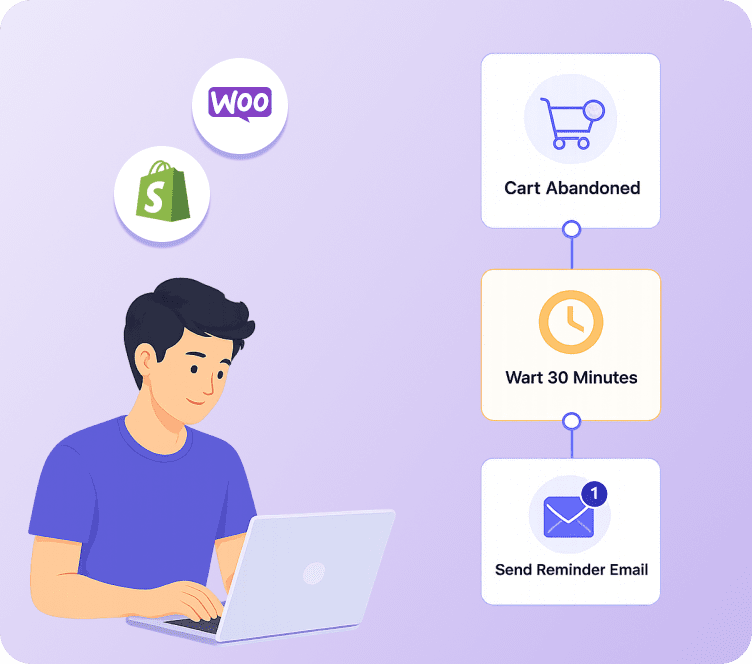
If they add an item to their cart and leave without buying, the same system can flag that and bring them back into the conversation through abandoned cart recovery. This is the kind of day-to-day, behavior-driven communication that contact management is built for and it’s exactly where most small businesses and growing brands spend their time.
CRM vs Contact Management: The Real Difference
Here’s the simplest way to think about it:
- CRM software is built for selling managing deals, pipelines, and revenue.
- Contact management software is built for communicating organizing your customer database and personalizing how you reach out.
Both systems store contact information. That overlap is exactly why people get confused. But the purpose behind that data is completely different.
A CRM asks: “Where is this person in our sales process, and what do we need to do to close them?”
A contact management system asks: “Who is this person, what do they care about, and how do we communicate with them in the most relevant way?”
Neither is universally “better.” It depends entirely on how your business actually operates and grows.
This is also why tools like Adflipr exist outside the traditional CRM category. Instead of trying to be everything at once, Adflipr is purpose-built around the “communicating” side of this equation helping businesses turn a simple contact database into an engine for ongoing, personalized conversations.
CRM vs Contact Management: Side-by-Side Comparison
| Aspect | CRM Software | Contact Management Software |
|---|---|---|
| Primary purpose | Manage sales pipeline and revenue | Organize and segment customer database |
| Best suited for | Sales teams, B2B, long sales cycles | Email marketing, small business, ecommerce |
| Core features | Deal tracking, pipeline stages, forecasting, task assignment | Contact segmentation, tagging, custom fields, communication history |
| Focus | Closing deals and tracking revenue | Building and nurturing customer relationships |
| Automation type | Sales automation (follow-up tasks, reminders) | Marketing automation (email sequences, behavior-based triggers) |
| Data emphasis | Deal value, stage, close probability | Contact details, interests, engagement, order tracking |
| Team using it | Sales representatives and sales managers | Marketers, founders, customer support |
| Complexity | Higher — built for structured sales processes | Lower — built for clarity and ease of use |
| Risk if mismatched | Overkill and underused for non-sales-driven teams | Insufficient for managing complex, multi-stage deals |
Features of CRM Software
A typical CRM system is built around a handful of core capabilities:
- Pipeline and deal management – visual boards showing every deal and its stage
- Lead management – capturing, scoring, and routing leads to the right rep
- Sales forecasting – predicting revenue based on deals in progress
- Task tracking – reminders for calls and follow-ups tied to a deal
- Reporting dashboards – visibility into team performance and sales-cycle length
These features matter for companies with dedicated sales teams and longer, relationship-driven sales cycles especially in B2B. If that’s not your day-to-day, these same features tend to sit unused.
Features of Contact Management Software
A contact management system is built differently from a CRM. Its features are designed around organizing people and personalizing communication and because this is the core of what most growing businesses need day to day, it’s worth understanding each piece in detail.
1. Centralized contact database Every contact’s information name, email, phone, location, custom notes — stored in one clean record instead of scattered across spreadsheets, inboxes, and tools.
2. Custom fields and tags The ability to capture exactly the data your business cares about (interest, purchase history, signup source, location) and group contacts accordingly. This is what makes personalization possible at scale.
3. Segmentation Splitting your audience into smaller, relevant groups so your messaging actually matches what each group cares about, instead of sending one generic email to everyone.
4. Communication and engagement history A full record of what emails a contact received, opened, clicked, or ignored visible at a glance through tools like analytics and reporting, so you always know what’s working.
5. Behavior-based automation Automatically moving a contact into a new workflow based on what they do. A click, a purchase, or a period of inactivity can all trigger the next step automatically, through marketing automation built around real customer behavior rather than manual effort.
6. Order tracking and purchase history For ecommerce and product-based businesses, contact management tools can tie purchase and order tracking data directly to a contact’s profile, helping you personalize future communication based on what they’ve already bought.
Together, these features are what make contact management software so effective for email marketing, customer retention, and audience-based growth and why it’s often the more practical starting point compared to a full CRM.
Contact Management for Small Business: Why It Often Wins
Here’s something many growing businesses get wrong: they assume that adopting a CRM is a sign of “leveling up,” so they invest in one before they actually need it.
In reality, contact management for small business is often the smarter starting point and here’s why.
Most small businesses and solo founders don’t have a dedicated sales team running multi-stage negotiations. What they actually need is to:
- Keep their customer list clean and organized
- Send relevant emails instead of generic blasts
- Understand who’s engaged and who’s gone quiet
- Automate follow-ups without manually tracking every contact
A full CRM, with its deal stages, sales forecasting, and pipeline reports, often goes unused in this scenario. Teams get overwhelmed by features they don’t need, training takes longer, and the tool becomes more of a burden than a benefit.
A focused contact management software solves the actual problem directly without the extra complexity.
Signs You Need Contact Management, Not a CRM
If you’re still unsure which side of this you fall on, these are the clearest signals that contact management software — not a CRM is the right fit:
- You’re sending the same email to your entire list because segmenting feels like too much manual work
- You have no easy way to tell who opened your last campaign and who didn’t
- Repeat customers don’t get any different treatment than first-time visitors
- Cart abandonment, inactivity, or re-engagement opportunities are slipping through because nothing’s automated
- Your “sales process” is really just answering questions and following up not managing multi-week negotiations
- You’ve looked at CRM pricing and features and felt like you’d be paying for a pipeline you’ll never build
If two or more of these sound familiar, you’re squarely in contact-management territory and that’s a good thing. It means the fix is simpler (and cheaper) than you might think.
CRM Benefits
When a business genuinely needs structured sales management, CRM benefits are real: full visibility into every deal, accurate forecasting, clear accountability across a sales team, and fewer deals going cold due to missed follow-up. These benefits matter most for B2B companies and agencies managing multi-touchpoint, contract-based sales.
Contact Management Benefits
For businesses focused on communication, audience growth, and customer retention, contact management benefits are just as significant and far more relevant for most small and growing businesses:
- Cleaner, more reliable data – no duplicate contacts or outdated information sitting across five different spreadsheets
- Personalized communication – messages based on real interests and behavior, not guesswork, sent through email marketing and an email builder built for exactly this
- Higher email engagement – relevant segmentation leads to better open and click rates, visible directly in analytics and reporting
- Recovered revenue – automated abandoned cart recovery brings back customers who were one step away from buying
- Stronger customer relationships – consistent, timely communication builds trust over time
- Simpler operations – less training, less complexity, faster adoption across your team
For ecommerce brands, content creators, and service businesses, these benefits often translate directly into more repeat customers and higher lifetime value.
How to Decide: CRM or Contact Management?
Instead of choosing based on which tool sounds more advanced, ask yourself these questions:
1. Does your business have a structured sales process with multiple stages and negotiations? If yes, a CRM system will likely serve you well.
2. Is your growth driven mainly by email marketing, audience segmentation, and customer engagement? If yes, contact management software is probably the better starting point.
3. Do you have a dedicated sales team that needs pipeline visibility and forecasting? This points clearly toward CRM.
4. Are you a small business, solopreneur, or ecommerce brand trying to personalize communication and automate follow-ups? This points clearly toward contact management.
5. Would your team actually use advanced sales features, or would they go untouched? Unused complexity isn’t a benefit it’s friction. Be honest about this one.
The right answer isn’t about which category of software is “better.” It’s about matching the tool to how your business actually generates and keeps customers.
Where Adflipr Fits In
If your business growth depends more on customer interactions, segmentation, and email automation than on managing a complex sales pipeline, that’s exactly the gap contact management software is built to fill and it’s exactly where Adflipr is designed to help.
Adflipr brings together a clean customer database, custom fields, behavior-based segmentation, and automated email workflows without burying your team in unused sales modules. In practice, this means:
- No more guesswork on who to email. Segments update automatically as contacts engage, so the right message reaches the right person at the right time.
- Higher engagement without extra manual work. Behavior-based triggers like a click, a purchase, or inactivity — automatically move contacts into the most relevant workflow.
- A single, reliable source of truth. Order history, communication history, and engagement data live on one contact profile, so your team never sends a disconnected or repetitive message.
- Faster adoption, fewer headaches. Because Adflipr is focused on communication rather than sales-pipeline complexity, teams pick it up quickly and actually use it which is where real engagement gains come from.
The result is straightforward: cleaner data, more relevant communication, and better engagement without the overhead of a full CRM your team may never fully use.
Explore how it works here: Adflipr Contact Management or see pricing to find the plan that fits your business.
Final Thoughts
CRM and contact management software both deal with customer relationships but they solve different problems. Customer relationship management systems are built for sales teams managing deals and forecasting revenue. Customer management software focused on contact management is built for businesses that grow through communication, segmentation, and consistent engagement.
Before choosing either, look honestly at how your business actually operates today not how you imagine it operating someday. The right tool is the one your team will actually use, not the one with the longest feature list.
Start with what your business needs right now. You can always add complexity later but you can’t get back the time lost to a tool that never fit in the first place.