
Every online store owner asks the same question at some point: is email marketing actually worth the time?
The short answer is yes, and the numbers back it up. But before you set up your first campaign, it helps to understand what email marketing really is, how it works behind the scenes, and how stores similar to yours are using it to bring back lost sales every single day.
So let’s start from the beginning.
What Is Email Marketing?
In simple terms, It is the practice of sending emails to people who have given you permission to contact them, with the goal of building a relationship and driving a specific action, like making a purchase, coming back to your store, or leaving a review.
For an ecommerce brand, email marketing is not just newsletters. It includes:
- Welcome emails when someone joins your list
- Abandoned cart emails when someone leaves without buying
- Promotional emails for sales, launches, and restocks
- Post-purchase emails like order confirmations, shipping updates, and review requests
- Win-back emails to bring dormant customers back
Unlike social media, your email list belongs to you. Instagram can change its algorithm overnight and cut your reach in half. Your email list stays yours, and every subscriber on it has already shown interest in your brand.
That’s why almost every profitable Shopify and WooCommerce store treats email as a core sales channel, not just a “nice to have.”
How Does Email Marketing Work?
At a basic level, email marketing works in four steps.
Step 1: Collecting Email Addresses
This usually happens through a signup form on your store, a discount popup, a checkout opt-in, or a landing page. The person gives permission to be emailed, which is what separates email marketing from spam.
Step 2: Organizing and Segmenting Your List
Not every subscriber should get the same email. A first-time visitor who signed up for 10% off is in a different stage than a customer who has bought from you five times. Segmentation groups people by behavior, purchase history, or interest, so each email feels relevant instead of random.
Step 3: Sending Campaigns and Automations
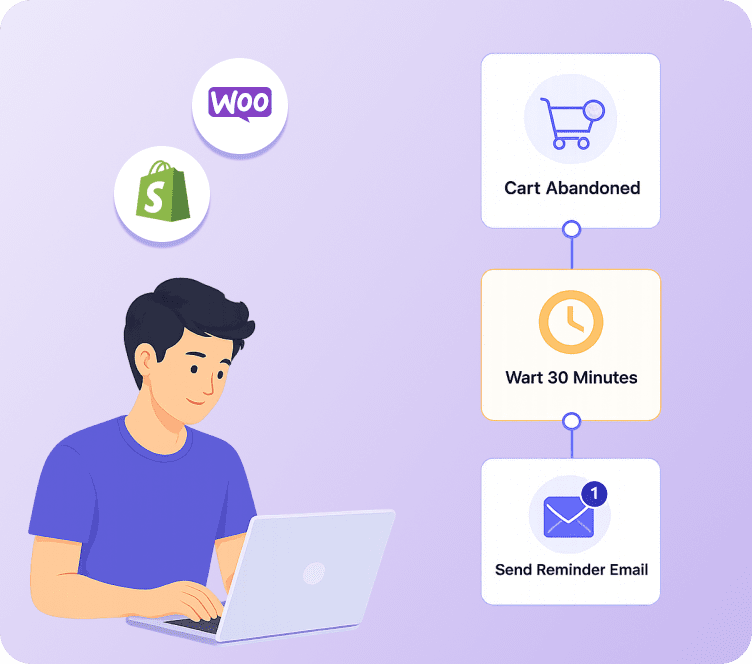
Campaigns are one-time sends, like a Black Friday announcement. Automations (sometimes called flows or journeys) are triggered by behavior and run on their own, like an email that goes out three hours after someone abandons their cart.
Step 4: Tracking Results and Improving
Every send gives you data: who opened it, who clicked, who bought something. That data tells you what to fix and what to repeat next time.
This cycle, collect, segment, send, track, repeat, is the entire engine behind email marketing. Platforms like Adflipr are built specifically to run this cycle for Shopify and WooCommerce stores, so store owners don’t have to stitch together separate tools for forms, automation, and analytics.
Benefits of Email Marketing for Ecommerce
The benefits of email marketing go far beyond “it’s cheap.” For an online store, here’s what it actually does:
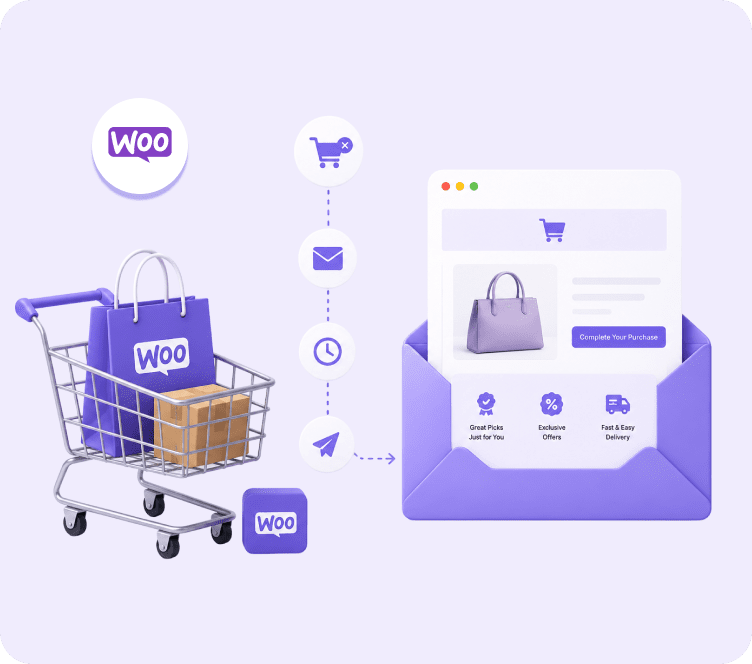
- Recovers lost revenue. Roughly 70% of online shopping carts get abandoned. A simple three-email abandoned cart sequence can recover a meaningful chunk of that automatically.
- Increases customer lifetime value. Post-purchase flows, loyalty emails, and personalized product recommendations keep customers buying again instead of buying once and disappearing.
- Gives you full ownership of your audience. You are not renting attention from a platform. Your list is yours, exportable, and not subject to algorithm changes.
- Works while you sleep. Automated flows like welcome series and cart recovery run 24/7 without you writing a new email every day.
- Is measurable down to the rupee or dollar. You can track exactly how much revenue came from a specific email, something that’s much harder to do with organic social posts.
- Costs less than paid ads over time. Once your list is built, sending to it is far cheaper than paying for clicks on Meta or Google every single time.
For a small Shopify store doing $10,000 to $50,000 a month, email marketing is often the single highest ROI channel available, because the audience already knows the brand.
Example of an Email Marketing Campaign
Let’s make this concrete with a real example of an email marketing campaign that a mid-sized skincare brand on Shopify could run.
Campaign goal: Recover abandoned checkouts during a product launch week.
Email 1, sent 1 hour after abandonment Subject line: “You left something behind” Content: A reminder of the exact product left in the cart, with a clear “Complete Your Order” button. No discount yet.
Email 2, sent 24 hours after abandonment Subject line: “Still thinking it over?” Content: Social proof, like a customer review or a before-and-after photo, plus an FAQ addressing common hesitations (shipping time, return policy).
Email 3, sent 48 hours after abandonment Subject line: “Here’s 10% off to help you decide” Content: A time-limited discount code, creating urgency with a 24-hour expiry.
Typical results for this kind of sequence: Store owners commonly see 10 to 15% of abandoned carts recovered through a three-email flow like this, compared to almost 0% recovery with no follow-up at all. On a store doing 500 abandoned carts a month at an average order value of $60, recovering just 12% of those carts adds roughly $3,600 in monthly revenue that would otherwise be lost.
This is the kind of automation that platforms built for ecommerce, including Adflipr, set up as a ready-to-use template, so you’re not building the logic from scratch.
Email Marketing Strategy for Ecommerce
A generic email marketing strategy for ecommerce looks the same for every business. A good one is built around your specific platform and customer journey.
Email Marketing Strategy for Shopify Stores
A solid Shopify email strategy usually includes:
- A welcome series triggered the moment someone joins your list, introducing your brand story and best sellers
- Abandoned cart and abandoned checkout flows (these are technically different events in Shopify, and both matter)
- Browse abandonment emails for people who viewed a product but never added it to cart
- Post-purchase flows with order updates, cross-sells, and review requests
- Win-back campaigns for customers who haven’t purchased in 60 to 90 days
- Segment-based promotional campaigns, so VIP customers get early access while new subscribers get an entry-level offer
Adflipr connects directly with Shopify, so cart, product, and order data sync automatically, meaning these flows can be built once and left running.
Email Marketing Strategy for WooCommerce Stores
WooCommerce stores often rely on plugins for cart and order tracking, so the strategy needs to account for that:
- Sync WooCommerce order and cart data into your email platform so abandoned cart triggers actually fire in real time
- Use purchase history to build “customers who bought X also liked Y” campaigns
- Set up stock alert emails for popular products that frequently sell out
- Run coupon-based win-back campaigns using WooCommerce’s native coupon system combined with automated email sends
Because WooCommerce sites vary a lot in setup, a platform like Adflipr that supports direct WooCommerce integration removes a lot of the manual data-syncing work that generic email tools require.
Metrics for Email Marketing
You can’t improve what you don’t measure. Here are the core metrics for email marketing every store owner should track.
| Metric | What It Tells You | Healthy Ecommerce Benchmark |
|---|---|---|
| Open Rate | How compelling your subject line is | 20-35% |
| Click-Through Rate | How relevant your content and offer are | 2-5% |
| Conversion Rate | What percentage of clicks turn into sales | 1-3% |
| Revenue Per Recipient | Average revenue generated per email sent | Varies by store, track your own baseline |
| Cart Recovery Rate | How many abandoned carts you win back | 5-15% |
| List Growth Rate | How fast your subscriber base is growing | 2-5% per month |
| Unsubscribe Rate | Whether your content matches expectations | Under 0.5% per campaign |
Most competitor articles stop at open rate and click rate. For an ecommerce store, revenue per recipient and cart recovery rate matter more, because they tie email performance directly to sales, not just engagement.
ROI of Email Marketing
The ROI of email marketing is often quoted as “$36 to $40 for every $1 spent,” and while that figure is real, it’s an industry average, not a guarantee.
Here’s how to actually calculate it for your store:
ROI = (Revenue from email − Cost of email platform) ÷ Cost of email platform × 100
Example: If your store generates $4,000 in monthly revenue attributed to email, and your email platform costs $80 a month, your ROI is:
($4,000 − $80) ÷ $80 × 100 = 4,900%
That number looks extreme, but it’s realistic once automations like abandoned cart and post-purchase flows are running, because those emails convert far better than one-off newsletters.
One detail most guides skip: your ROI is directly affected by how your email platform charges you. Some platforms bill based on your total contact list, even if half those contacts never open an email. Adflipr and similar ecommerce-focused platforms bill based on active contacts, meaning you’re not paying full price for people who have gone silent. That pricing model alone can meaningfully change your real ROI, especially for stores with large but only partially engaged lists.
Best Practices for Email Marketing
These best practices for email marketing are the ones that actually move revenue for ecommerce stores, not just generic sending advice.
- Segment before you send. A first-time visitor and a repeat customer should never get the identical email.
- Personalize beyond a first name. Use browsing and purchase history to recommend relevant products.
- Automate the obvious moments. Welcome, cart abandonment, and post-purchase flows should run automatically, not be sent manually.
- Test one variable at a time. Subject line, send time, or discount amount, not all three at once, so you know what actually caused the change.
- Clean your list regularly. Remove people who haven’t opened anything in 6+ months to protect your sender reputation.
- Match email frequency to your catalog. A store that restocks weekly can email more often than one that launches twice a year.
- Always mobile-optimize. Over 60% of ecommerce emails are opened on a phone, so test every email on mobile before sending.
Email Marketing Mistakes
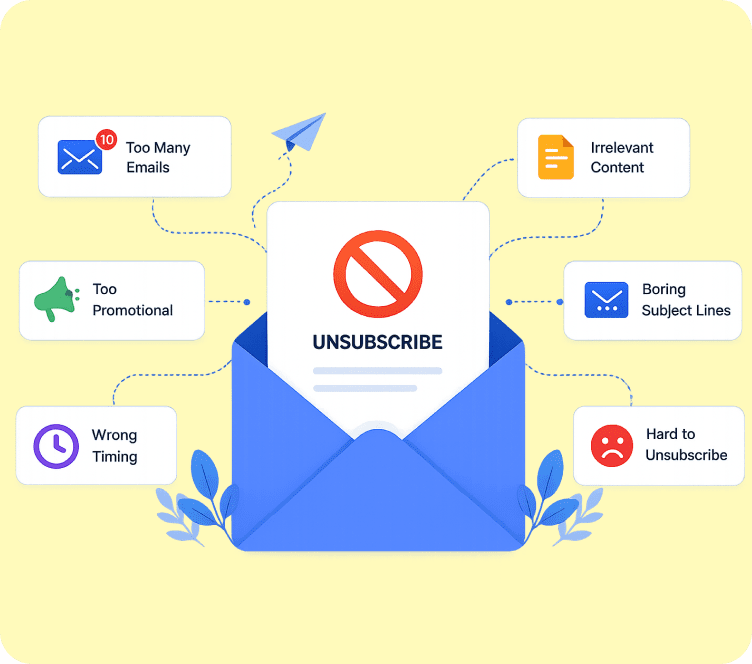
Here are the email marketing mistakes that specifically hurt ecommerce stores, beyond the usual “don’t send too many emails” advice.
- Ignoring browse abandonment. Most stores only email people who added to cart, missing everyone who viewed a product but didn’t add it.
- Sending the same discount to everyone. Giving new subscribers and loyal repeat customers the identical 10% off devalues your top customers.
- Not connecting store data properly. If your Shopify or WooCommerce integration isn’t set up correctly, automations trigger late or not at all, and you lose the revenue window.
- Treating email as only promotional. Stores that only send “buy now” emails see declining engagement over time. Mix in educational and story-driven content.
- Skipping A/B testing. Guessing which subject line works instead of testing leaves easy wins on the table.
- Forgetting deliverability basics. Skipping SPF, DKIM, and DMARC setup can land your emails in spam, no matter how good the content is.
Email Marketing Checklist
Use this email marketing checklist before launching or reviewing your program.
- Signup forms are live on your homepage, product pages, and checkout
- Welcome series is built and automated
- Abandoned cart flow is connected to your Shopify or WooCommerce store
- Browse abandonment flow is set up for high-intent, non-cart visitors
- Post-purchase flow includes order updates and a review request
- List is segmented by purchase behavior, not just demographics
- SPF, DKIM, and DMARC are configured correctly
- Every campaign has a clear, single call to action
- You’re tracking revenue per recipient, not just open rate
- Your platform bills based on active contacts, not dead weight on your list
- You have a win-back flow for customers inactive 60-90 days
- Unsubscribe and preference options are easy to find
Email Marketing KPIs
While metrics tell you what happened, email marketing KPIs are the specific numbers you set as targets and review regularly. For an ecommerce store, the KPIs worth reporting on monthly are:
- Total revenue attributed to email
- Percentage of total store revenue coming from email
- Cart recovery rate
- List growth rate
- Revenue per recipient, tracked campaign over campaign
- Customer retention rate among email subscribers vs. non-subscribers
Reviewing these six numbers monthly gives you a much clearer picture of program health than open rate and click rate alone, which is where most generic guides stop.
How Adflipr Helps You Do Email Marketing
Everything covered above, segmentation, automation, cart recovery, KPIs, is easier to actually run when your platform is built for ecommerce instead of adapted for it. Here’s where Adflipr fits into the picture:
- Native Shopify and WooCommerce integration. Product, order, and cart data sync automatically through Shopify email marketing and WooCommerce email marketing integrations, so triggers like abandoned cart or browse abandonment fire in real time instead of with a delay.
- Ready-to-use ecommerce automation templates. Welcome series, abandoned cart, browse abandonment, post-purchase, and win-back flows come pre-built inside marketing automation, so you’re customizing a proven structure instead of building logic from scratch.
- Behavior-based segmentation. Customer segmentation groups subscribers by purchase history, browsing activity, or order value without manual list management.
- Revenue-first reporting. See revenue per recipient, cart recovery rate, and campaign-level ROI in one place through built-in email marketing analytics, not just open and click rates.
- Active contact billing. You pay based on contacts who are actually engaging, not your full, unfiltered list size, which keeps your real ROI higher as your list grows.
If you’re setting up your first flow or auditing an existing one, this is the part of the checklist above where a platform built specifically for Shopify and WooCommerce makes the difference between “email marketing in theory” and revenue that shows up in your reports every month.
Key Takeaways
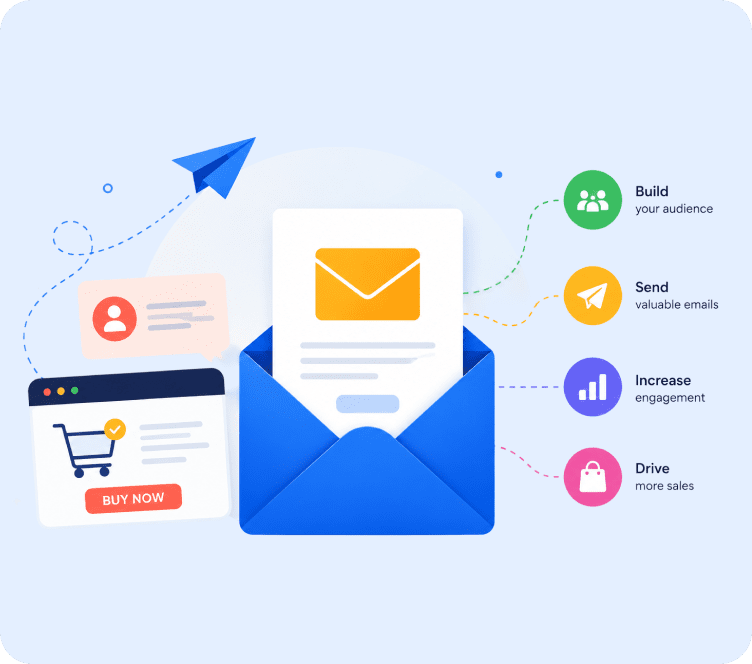
So, what is email marketing, really? It’s a direct, owned channel that lets ecommerce stores turn one-time visitors into repeat customers, recover abandoned sales automatically, and generate measurable revenue without depending on an algorithm.
The stores that get the most out of it are the ones that go beyond a monthly newsletter. They segment their list, automate the key moments (welcome, cart recovery, post-purchase), track ecommerce-specific KPIs like revenue per recipient, and choose a platform built for how Shopify and WooCommerce stores actually operate.
If you’re evaluating tools, look for ecommerce-native integrations, automation templates for cart recovery and post-purchase flows, and pricing based on active contacts rather than your total list size. That combination is what turns email marketing from a checkbox into one of your store’s most profitable channels. Adflipr is built around exactly this, connecting directly with Shopify and WooCommerce so your data, automations, and billing all work the way an ecommerce store actually needs.
FAQs
What is email marketing?
Email marketing is the practice of sending emails to people who have opted in, with the goal of building relationships and driving actions like purchases, repeat visits, or reviews. For ecommerce stores, it includes welcome emails, abandoned cart flows, promotional campaigns, and post-purchase sequences, all working together to turn subscribers into customers.
How does it actually work?
It works in four stages: collecting email addresses through signup forms or checkout opt-ins, segmenting your list by behavior or purchase history, sending campaigns and automated flows, and tracking results to improve future sends. Ecommerce platforms like Shopify and WooCommerce can connect directly to email tools so this cycle runs automatically.
Why does it matter for ecommerce stores?
It works in four stages: collecting email addresses through signup forms or checkout opt-ins, segmenting your list by behavior or purchase history, sending campaigns and automated flows, and tracking results to improve future sends. Ecommerce platforms like Shopify and WooCommerce can connect directly to email tools so this cycle runs automatically.
What kind of ROI should you expect?
Industry averages put email marketing ROI around $36 to $40 for every $1 spent, though actual results depend on your automation setup and list quality. ROI is calculated as (revenue from email minus platform cost) divided by platform cost, multiplied by 100. Automated flows like cart recovery typically drive the highest ROI of any single email type.
What mistakes should you avoid?
Common mistakes include ignoring browse abandonment, sending identical discounts to new and loyal customers, poor integration between your store and email platform, only sending promotional content, skipping A/B testing, and neglecting deliverability setup like SPF and DKIM records.
Is it worth it for Shopify stores?
Yes. Shopify stores benefit from direct integrations that sync cart, product, and order data automatically, making it easy to run abandoned cart, browse abandonment, and post-purchase flows without manual work. Most profitable Shopify stores treat email as one of their top two or three revenue channels.
Does it work well for WooCommerce stores too?
Yes, though WooCommerce stores need to make sure their email platform properly syncs cart and order data, since this often depends on plugin setup. Once connected correctly, WooCommerce stores can run the same abandoned cart, win-back, and segmentation strategies that drive results for any ecommerce brand.