
If you run a Shopify or WooCommerce store, you already know the feeling. Traffic is coming in, but sales aren’t growing the way they should. You’re not alone. Most store owners searching for how to increase ecommerce sales aren’t looking for another generic checklist. They want to know exactly what to fix first, what tools actually move the needle, and how stores similar to theirs went from flat revenue to consistent growth.
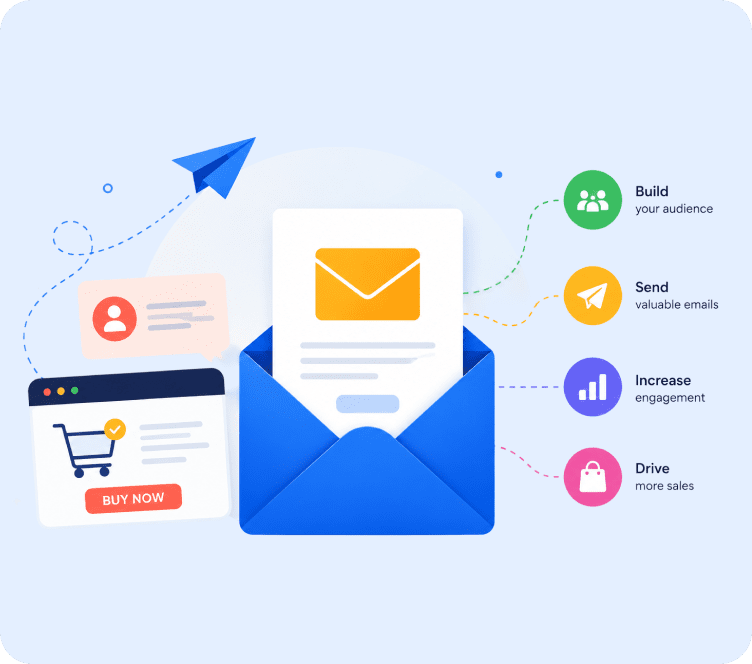
This guide covers both sides of the equation: getting more people to buy, and getting the people who already bought to come back. That second part is where most stores leave the most money on the table, and it’s exactly where smart email marketing and automation change the game.
What Actually Increases Ecommerce Sales?
In short, ecommerce sales grow when you improve three things at the same time: the number of visitors who buy (conversion rate), how much they spend per order (average order value), and how often they return (customer lifetime value). You don’t need to pick one. The fastest growth comes from small improvements across all three, especially through email marketing automation, since it directly touches conversion, order value, and repeat purchases.
That’s the framework this whole article is built around. Let’s break it down step by step.
1. Fix Your Website and Product Pages First
Before you spend a rupee or dollar on ads or email tools, make sure your store isn’t leaking sales on its own. This is the foundation of any ecommerce conversion rate optimization effort.
Things to check right now:
- Page speed. A slow product page loses buyers before they even scroll. Compress images and remove unused apps or plugins.
- Clear product photos and descriptions. Show the product from multiple angles, in use, and with real dimensions. Vague descriptions create doubt, and doubt kills sales.
- Simple navigation. Customers should reach any product in three clicks or less.
- Mobile checkout. More than half of ecommerce traffic is mobile. If checkout is clunky on a phone, you’re losing sales daily.
Shopify example: A skincare brand on Shopify cut its bounce rate by rewriting product descriptions to answer real customer questions (like “will this work for sensitive skin”) instead of just listing ingredients.
WooCommerce example: A home decor WooCommerce store reduced page load time by 1.8 seconds after compressing product images, and saw checkout completions go up within a month.
2. Capture More Emails With Smart Opt-Ins and Popups
You can’t run email marketing without an email list, and most stores only capture a small fraction of their visitors. This is one of the simplest ways to increase online sales without spending more on ads.
Use opt-in popups that:
- Trigger on exit intent, not the second someone lands on your site
- Offer a real incentive (10% off, free shipping, or early access to a sale)
- Ask for just an email first, and phone number later if you want SMS too
- Appear on high-traffic pages like your blog, homepage, and collection pages
A good popup strategy alone can add 3 to 5% more subscribers to your list every month, and every one of those subscribers is a future sale if you follow up correctly, which brings us to the most important part.
3. Turn Subscribers Into Buyers With Email Marketing Automation
This is where most guides on how to grow ecommerce sales stay surface level. They mention “email marketing” as a single bullet point. In reality, automation is a system with several connected flows, and this is exactly what a platform like Adflipr is built for: dedicated Shopify email marketing and WooCommerce email marketing automation, priced around active contacts instead of your entire dead list.
Here are the automations that matter most:
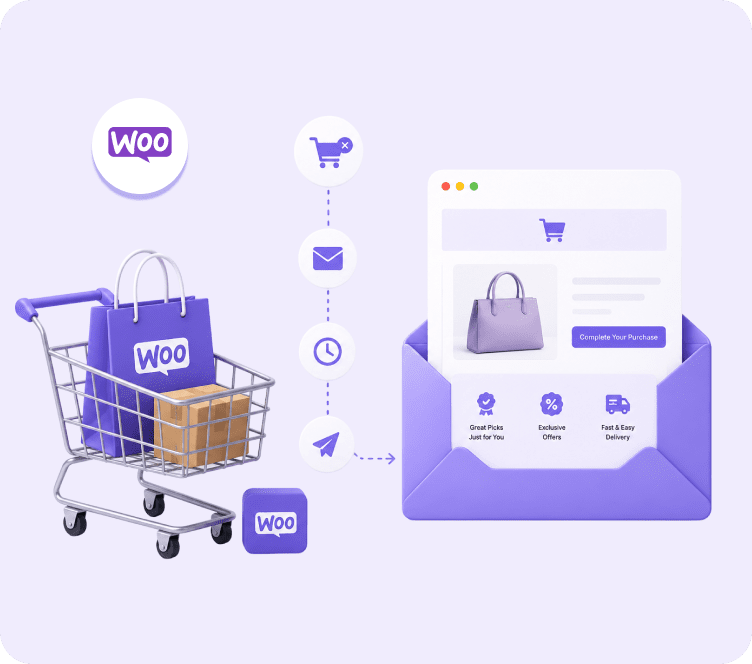
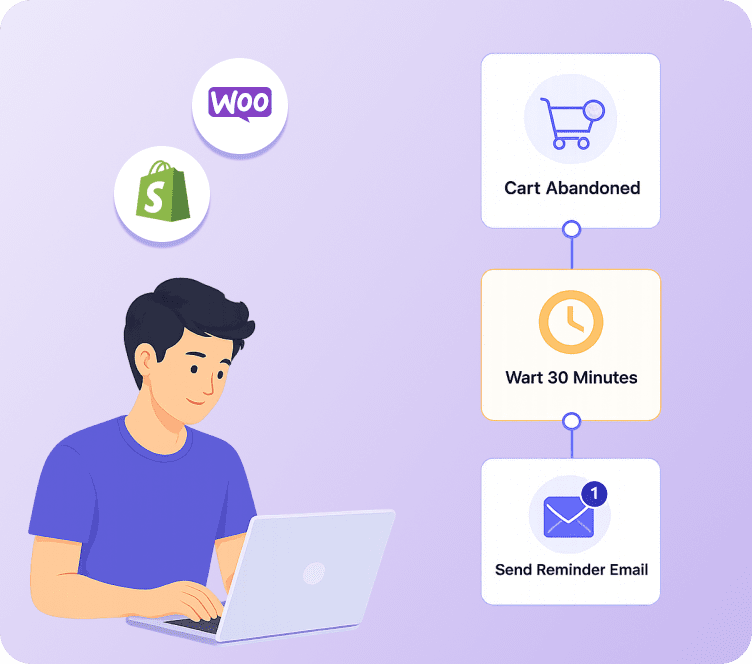
Abandoned Cart Recovery
Roughly 7 out of 10 online shoppers add products to cart and leave without buying. An abandoned cart email sequence brings a meaningful chunk of them back.
A simple, effective flow looks like this:
- Email 1 (1 hour later): Remind them what’s in their cart, no discount yet.
- Email 2 (24 hours later): Add urgency, mention limited stock if true.
- Email 3 (48 to 72 hours later): Offer a small discount or free shipping to close the sale.
Shopify example: A fashion store recovered close to 12% of abandoned carts after adding a three-email sequence instead of a single reminder.
Browse Abandonment Emails
Not everyone adds to cart before leaving. If someone viewed a product three or more times but never added it, send a gentle nudge showing that product along with similar options.
Post-Purchase Automation
The sale isn’t the end of the relationship, it’s the start. Post-purchase emails can include:
- Order confirmation with a “customers also bought” section
- Shipping and delivery updates
- A follow-up asking for a review once the product arrives
- A replenishment reminder if the product runs out (perfect for supplements, skincare, or consumables)
Customer Win-Back Emails
This is one of the highest ROI automations and one of the most overlooked. Win-back emails target customers who haven’t purchased in 60, 90, or 120 days. A simple “we miss you” email with a personalized offer based on their past purchase can bring back a customer at a fraction of what it costs to acquire a new one.
WooCommerce example: A pet supplies WooCommerce store set up a 90-day win-back flow offering 15% off a customer’s previously purchased category. It became one of their top three revenue-generating automations, outperforming several one-off campaigns.
4. Segment Your Customers So Every Email Feels Personal
Sending the same email to your entire list is one of the fastest ways to get ignored. Customer segmentation lets you group subscribers by behavior, such as:
- First-time buyers vs. repeat customers
- High spenders vs. discount shoppers
- Category interest (someone who only buys skincare doesn’t need your electronics emails)
- Engagement level (active openers vs. inactive subscribers)
Segmented campaigns consistently get higher open rates and click rates than one-size-fits-all blasts, because the message actually matches what the person cares about.
5. Increase Average Order Value With Upsells and Bundles
Getting someone to buy is only half the win. Getting them to buy more per order increases sales without increasing your ad spend.
Practical tactics:
- Cart page upsells: “Add this for 20% off” right before checkout.
- Bundles: Group complementary products at a small discount versus buying separately.
- Free shipping threshold: “Free shipping on orders over $50” nudges people to add one more item.
- Post-purchase upsell: Offer a related product on the thank-you page, right after they’ve already committed to buy.
6. Build Trust With Reviews and Social Proof
Shoppers trust other shoppers more than they trust your product description. Display star ratings, written reviews, and photos from real customers on product pages. Follow up every order with a review request email a few days after delivery, when the product experience is still fresh.
7. Retention: The Fastest Path to Growing Ecommerce Sales
Most stores over-focus on new customer acquisition and under-invest in the customers they already have. Solid customer retention strategies for ecommerce are usually cheaper and faster to implement than acquisition campaigns, and they compound over time.
Retention tactics worth prioritizing:
- Loyalty or points programs for repeat purchases
- VIP early access to new products or sales
- Personalized product recommendations based on past orders
- Regular but not overwhelming email cadence (weekly or biweekly, not daily)
Manual Marketing vs. Automated Ecommerce Marketing
| Factor | Manual, one-off emails | Automated ecommerce marketing (like Adflipr) |
|---|---|---|
| Time required | High, sent manually each time | Set up once, runs continuously |
| Personalization | Generic, same message to everyone | Based on behavior, segment, and purchase history |
| Cart recovery | Rarely followed up | Automatic multi-step recovery flow |
| Win-back campaigns | Usually skipped entirely | Runs automatically at 60/90/120 days |
| Pricing model | N/A | Often billed on active, engaged contacts only |
| Platform fit | Generic tools | Built for Shopify and WooCommerce specifically |
Common Mistakes to Avoid
- Sending one abandoned cart email and stopping. A single email recovers far fewer sales than a proper sequence.
- Emailing your entire list the same message. This tanks engagement and can hurt deliverability over time.
- Ignoring win-back campaigns. Letting past customers go quiet without ever reaching out is leaving free revenue on the table.
- Paying for your whole subscriber list regardless of engagement. This inflates costs without improving results, which is why active-contact pricing matters for small and growing stores.
- Treating email as a broadcast tool instead of an automation system. The real growth comes from flows that run in the background, not just newsletters.
Best Practices Checklist
- Audit your product pages and checkout flow for friction
- Add exit-intent popups with a real incentive
- Set up abandoned cart, browse abandonment, post-purchase, and win-back flows
- Segment your list by behavior, not just demographics
- Test one upsell or bundle offer at checkout
- Collect and display reviews consistently
- Review your automation performance monthly and adjust timing or offers
key Takeaways
If you’re wondering how to increase ecommerce sales, the honest answer is that there’s no single trick. It’s a combination of a smooth buying experience, smarter email capture, and automation that keeps talking to your customers after they leave your site, through abandoned cart recovery, post-purchase flows, and win-back emails. Stores that treat email marketing as a full system instead of an occasional newsletter consistently see stronger, more predictable growth.
If you’re running a Shopify or WooCommerce store and want this kind of automation without overpaying for your entire subscriber list, Adflipr is built specifically for that, with ready-made ecommerce flows, active-contact pricing, and native integrations for both platforms. Start with one automation, get it working well, and build from there.
FAQs
What is the fastest way to increase ecommerce sales?
The fastest way is usually fixing checkout friction and setting up an abandoned cart email sequence. Both address sales you’re already close to making but losing due to a slow site or a missed follow-up. Most stores see results within a few weeks of fixing these two areas, before touching bigger strategies like paid ads.
How does email marketing help increase ecommerce sales?
Email marketing helps by recovering abandoned carts, encouraging repeat purchases, and bringing back inactive customers through win-back campaigns. Unlike paid ads, email reaches people who already know your brand, which usually makes it far more cost effective for increasing sales ecommerce stores can rely on month after month.
Why is customer retention important for increasing ecommerce sales?
Retaining existing customers costs less than acquiring new ones, and repeat customers tend to spend more over time. Focusing on customer retention strategies for ecommerce, like loyalty programs and win-back emails, creates a more stable and predictable revenue base than constantly chasing new traffic.
What mistakes should I avoid when trying to grow ecommerce sales?
Avoid sending only one abandoned cart email, blasting your entire list with the same generic message, and ignoring customers who’ve gone quiet. Also avoid paying for inactive subscribers on a flat list-size pricing plan, since that wastes budget without improving actual results.
Is email marketing automation worth it for small Shopify stores?
Yes. Even small Shopify stores benefit from automation because it runs in the background without added manual work. A basic abandoned cart and welcome flow can start recovering sales within the first week of setup, making it one of the highest ROI investments for a growing store.
Is email marketing automation useful for WooCommerce stores too?
Yes. WooCommerce stores can use the same core automations, abandoned cart, post-purchase, and win-back flows, as Shopify stores. The main difference is the integration setup, so choosing a platform built to support WooCommerce natively, like Adflipr, makes implementation much smoother.
How do popups help increase online sales?
Popups help increase online sales by capturing emails from visitors who aren’t ready to buy yet. Once they’re on your list, automated email flows can bring them back later with the right offer at the right time, turning a browsing visitor into a paying customer over days or weeks.
How often should I send win-back emails to inactive customers?
A common approach is sending the first win-back email around 60 days of inactivity, a second around 90 days with a stronger offer, and a final one around 120 days. Timing can vary by product type, but the key is not waiting so long that the customer has already moved to a competitor.