
A customer visits your store, browses your products, and adds something to their cart. For a moment, it feels like a sale is guaranteed.
Then they leave. No checkout. No payment. Just another empty cart and a lost opportunity.
If you run an online business, you’ve watched this happen more times than you’d like. It’s frustrating, because these weren’t random visitors. They were already interested enough to act.
So what went wrong?
According to the Baymard Institute, the average online store loses roughly 70% of carts before checkout is completed. Across the industry, that adds up to an estimated $260 billion in lost sales every year. Some sectors fare even worse: automotive and big-ticket categories report drop-off rates closer to 89%, since those purchases involve more research, more comparison shopping, and more hesitation before someone commits.
The good news is that most of that revenue isn’t gone for good. These weren’t lost leads. They were shoppers who got close enough to buy and then stopped for a reason. Once you understand that reason, you can address it directly, and a meaningful share of that “lost” revenue comes back.
This guide goes deep into why shoppers walk away mid-purchase, how to measure the problem accurately, and what to actually do about it, from quick checkout fixes to fully automated recovery sequences.
Top Reasons Shoppers Abandon Their Cart
| Reason | Share of Abandonments | Quick Fix |
|---|---|---|
| Extra costs too high (shipping, tax, fees) | ~48% | Show full price early in the journey |
| Forced to create an account | ~24% | Offer guest checkout |
| Checkout process too long or complicated | ~18% | Cut steps and form fields |
| Couldn’t see total cost upfront | ~17% | Display cost breakdown before final step |
| Didn’t trust the site with card details | ~17% | Add trust badges and reviews |
| Delivery too slow | ~16% | Offer faster or more flexible shipping options |
| Website errors or crashes | ~13% | Test checkout regularly across devices |
Figures are approximate, based on aggregated industry research including Baymard Institute studies. Percentages don’t add up to 100% since shoppers often cite more than one reason.
What Is Cart Abandonment (And Why It’s Not the Same as Checkout Drop-off)
Cart abandonment happens when someone adds a product to their cart but exits the site before paying. It’s a slightly broader behavior than what’s sometimes called checkout abandonment, which refers specifically to shoppers who actually start the checkout flow (entering shipping or payment info) and then bail before finishing. Checkout drop-off is usually a sharper signal that something in the process itself, like a form, a fee, or a missing payment method, caused the exit, rather than a more general loss of interest earlier in the journey.
The distinction matters for how you fix it. A shopper who abandons a cart on a product page might just be comparison shopping or saving items for later. That’s a marketing problem, solved with reminders and retargeting. A shopper who abandons mid-checkout, after entering an address or selecting a shipping method, ran into a specific obstacle. That’s a UX problem, solved by fixing the obstacle itself.
Either way, the shopper wasn’t just browsing. They were close. They liked the product, explored your site, and moved toward buying. Something got in the way at the last moment.
Treating this purely as a loss misses the opportunity. With the right approach, a large share of these near-buyers can be brought back and converted, and recovering them is almost always cheaper than acquiring a brand-new customer from scratch.
How to Calculate Your Abandonment Rate
Before fixing the problem, it helps to know how big it actually is for your store, and whether your efforts are working over time. The formula is simple:
Abandonment rate = (1 − (completed purchases ÷ initiated checkouts)) × 100
For example, if 1,000 shoppers started checkout last month and 300 completed their purchase, your rate would be (1 − (300 ÷ 1,000)) × 100 = 70%, right in line with the industry average.
A few things to keep in mind when you run this number:
- Calculate it by traffic source. Paid social traffic, organic search traffic, and email traffic often abandon at very different rates. Lumping them together hides which channel needs the most attention.
- Segment by device. Mobile abandonment is almost always higher than desktop, often because checkout forms aren’t optimized for smaller screens.
- Track it monthly, not just once. A single snapshot tells you where you stand. A trend line tells you whether your fixes are actually working.
This number becomes your baseline. Every change you make, whether it’s a shorter checkout form, a new payment option, or a recovery email sequence, should move it in a measurable direction. If it doesn’t, that’s useful information too: it tells you the change you made wasn’t addressing the real friction point.
Why Shoppers Leave Without Buying
Most drop-off isn’t random. It follows a handful of predictable, well-documented patterns. Understanding the psychology behind each one is what separates a guess from a fix that actually works.
They Don’t Fully Trust the Site Yet
At checkout, customers are handing over payment details and personal information. Any flicker of doubt at that moment can stop them cold, even if everything up to that point went smoothly.
Common credibility gaps include:
- No reviews or testimonials anywhere on the page
- Vague or missing return/refund terms
- No visible contact information
- A site that looks dated or poorly built
- No visible security badges near the payment fields
Trust isn’t built in one place. It accumulates across the whole experience, from the first product photo to the final “Pay Now” button. If a shopper doesn’t feel safe, they won’t enter their card number, no matter how much they like the product itself.
The Price Changes at the Worst Possible Moment
Few things kill a sale faster than a final total that doesn’t match what the shopper expected. They were comfortable with the listed price, then shipping or taxes show up unannounced at the last step. Research from McKinsey has found that the large majority of shoppers will back out of a purchase entirely when shipping costs feel disproportionate to the product price.
Even when the charges are entirely fair and clearly disclosed somewhere on the site, the surprise itself reads as dishonest in the moment it happens. Showing the full cost early, not at the final click, protects the trust you’ve already built earlier in the journey.
The Path to Checkout Has Too Many Steps
A buying decision can unravel fast if the process feels like work. Forcing an account creation, asking for unnecessary fields, or stretching checkout across multiple pages all add friction that a motivated buyer didn’t sign up for. Baymard’s research consistently finds that roughly one in five abandonments happen specifically because the checkout process felt too long or too complicated.
People expect speed, especially on mobile, where typing is slower and patience is shorter. Every extra click, every redundant field, and every unnecessary redirect is a chance for the shopper to reconsider, or simply give up out of frustration.
Last-Minute Doubt Creeps In
Sometimes nothing is technically wrong with your site at all. The customer simply starts second-guessing themselves:
“Do I actually need this right now?” “Could I find it cheaper somewhere else?” “Maybe I should wait for a sale.”
This kind of hesitation, sometimes called purchase anxiety, is completely normal. It shows up even when pricing, trust, and checkout speed are all handled well. If your checkout experience does nothing to settle that doubt, with no reassurance, no urgency, and no easy way to act, it often wins, and the cart sits untouched.
Limited Payment Options Create an Unnecessary Dead End
A shopper can clear every other hurdle and still abandon at the very last step if their preferred way to pay simply isn’t offered. This is one of the more avoidable causes of drop-off, since it’s purely a configuration choice rather than a deeper trust or pricing issue, but it still accounts for a meaningful share of lost sales, especially in markets where digital wallets or installment options are the norm.
Proven Ways to Bring Shoppers Back to Checkout
Once you know where the friction lives, here’s how to remove it, and recover the sales that almost happened.
1. Send Automated Recovery Emails
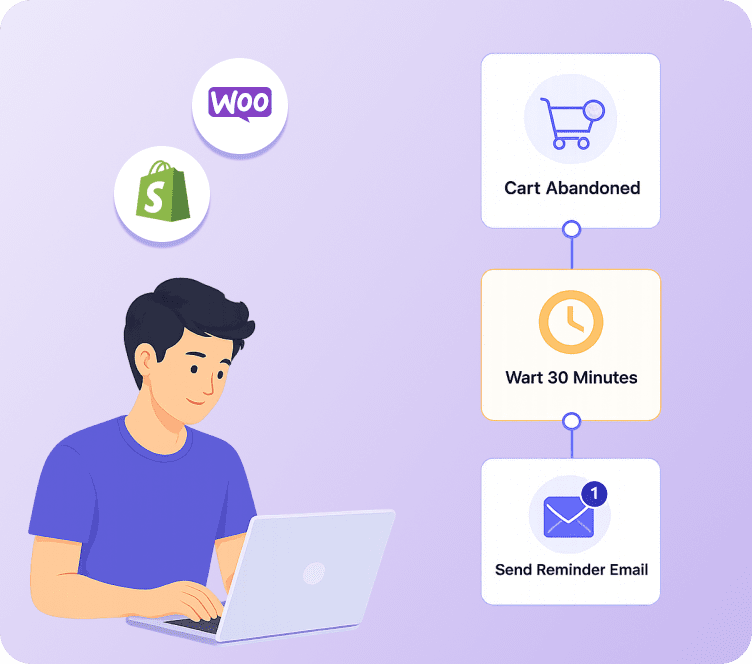
Distraction, not disinterest, accounts for a huge share of abandoned carts. People get pulled away by a phone call, a notification, or simply forget to come back. A well-timed nudge can pull shoppers right back to where they left off, often without any extra persuasion needed.
A simple, effective sequence looks like this:
- First message within an hour, while the product is still top of mind and intent is highest
- A follow-up within 24 hours, reinforcing benefits, reviews, or social proof
- A final message with a small incentive, such as free shipping or a modest discount, for shoppers who still haven’t returned
Each email in this sequence should restore the cart exactly as the shopper left it. Making them re-search for the product or re-select options adds back the friction you’re trying to remove.
Doing this manually doesn’t scale past a handful of orders a day. Platforms like Adflipr’s marketing automation handle the entire sequence so recovery happens consistently, without anyone managing it by hand. Pair it with Adflipr’s abandoned cart recovery tools to track which carts are at risk in real time and trigger the right message automatically.
2. Strip Friction Out of Checkout
A faster path to “buy” almost always means fewer drop-offs, particularly on mobile, where every extra tap costs more attention than it does on desktop.
Focus on:
- Offering guest checkout, so account creation never blocks a first-time buyer
- Cutting form fields down to what’s strictly essential
- Reducing the number of steps between cart and confirmation
- Adding a visible progress indicator so shoppers know how much is left
- Making sure pages load quickly, especially on mobile networks
The less a shopper has to think or wait, the more likely they are to finish what they started.
3. Build Confidence Before the Payment Page
Customers need reassurance before they’re willing to hand over financial details, and that reassurance has to show up before the payment form, not after.
- Show secure-payment badges near the checkout button
- Display genuine customer ratings and reviews, ideally near the product and again at checkout
- Make return and refund terms easy to find, not buried in a footer link
- List clear contact details, not just a generic contact form
These small signals add up to a site that feels trustworthy rather than risky, which matters most in the seconds right before someone clicks “Pay.”
4. Show the Full Price Early
Hidden costs are one of the fastest ways to lose a sale that was otherwise locked in, and one of the easiest to fix once you know it’s happening.
- Display the total cost as early in the journey as possible, ideally on the product or cart page
- Spell out shipping and tax estimates before the final step, not after
- Avoid introducing any charge the shopper hasn’t already seen somewhere earlier
Pricing honesty isn’t just good practice. It’s one of the strongest trust signals you can offer, and it directly addresses the single most common reason shoppers cite for leaving.
5. Use Urgency, But Keep It Real
A nudge toward faster action works well for shoppers stuck in indecision, as long as it’s genuine and verifiable.
- Low-stock notices, but only when inventory is actually limited
- Countdown timers tied to real, time-bound offers
- Clear messaging when a deal is about to expire
Manufactured urgency, like fake countdowns or “3 people are viewing this” messages that never change, erodes trust fast once a shopper notices the pattern. Honest urgency, on the other hand, simply speeds up decisions that were already close to being made.
6. Let Other Customers Do the Convincing
Shoppers tend to trust other buyers more than they trust a brand’s own claims about its product.
- Star ratings and written reviews
- Testimonials from real, named customers
- Photos submitted by actual buyers
- “Best Seller” or “Trending” labels on genuinely popular items
This kind of proof quietly removes the “is this actually good?” hesitation that otherwise sits unanswered in the back of a shopper’s mind through the entire checkout flow.
7. Don’t Limit How People Can Pay
If a shopper’s preferred payment method isn’t available, they often leave rather than find a workaround, and they rarely come back to try a different method later.
- Standard credit and debit cards
- UPI and digital wallets
- Buy Now, Pay Later options for higher-ticket items
More flexibility at the payment step means fewer last-second exits over something that has nothing to do with the product itself.
8. Personalize the Follow-Up
Generic messaging gets ignored. Behavior-based messaging gets opened, read, and acted on.
- Use the shopper’s name
- Reference the exact item left behind, with an image if possible
- Suggest related products based on what they browsed
- Trigger follow-ups based on what they actually did on-site, not a one-size-fits-all template
Tools like Adflipr’s email marketing and drag-and-drop email builder make it easy to personalize at scale instead of writing one-off messages for every segment by hand.
9. Get the Timing Right
Recovery only works if it reaches the shopper while interest is still warm. Wait too long, and they’ve either bought from a competitor or simply moved on mentally.
- First reminder within an hour
- Second reminder within 24 hours
- A final, incentive-led message within three days if there’s still no response
Automation is what makes consistent timing possible. Manually tracking when each individual cart was abandoned isn’t realistic past a handful of orders a week, and timing is one of the few variables in this entire process that’s almost entirely under your control.
What Happens If You Do Nothing
It’s worth being direct about the cost of inaction here. Every abandoned cart represents a customer who already did the hard part. They found your store, found a product they wanted, and got within one click of paying for it. Letting that interest evaporate without even a single follow-up email is, in effect, leaving revenue on the table that required zero additional ad spend to generate.
Recovering even a modest share of abandoned carts (Baymard’s research suggests well-run recovery programs can lift completed checkouts by over 30%) typically costs far less than acquiring an equivalent number of new customers through paid channels. That’s the core reason cart recovery deserves the same attention as your acquisition funnel, not just an afterthought bolted on after launch.
Quick Checklist to Reduce Cart Abandonment
If you want to start improving results this week, prioritize:
- Show the full price upfront, before checkout
- Simplify checkout to the fewest steps possible
- Turn on guest checkout
- Add visible trust signals and reviews
- Automate cart recovery emails
- Offer more than one payment method
- Calculate your abandonment rate monthly and track the trend
Even small wins on this list tend to show up quickly in that number, since most of these fixes target the friction points shoppers run into most often.
Want a clearer view of where your store is losing carts? Adflipr’s analytics and reporting tools surface drop-off points so you know exactly which fix to prioritize first. And if you sell on WooCommerce or Shopify, the WooCommerce and Shopify integrations connect cart data directly into your recovery workflows, so nothing has to be tracked or triggered by hand.